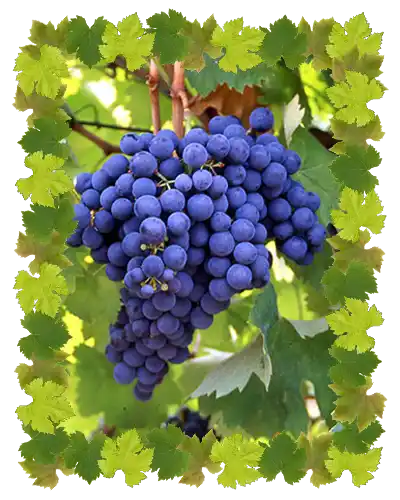
A very typical Piedmontese grape variety, already mentioned in a 1514 document near Chieri, today it covers 35 percent of Piedmont’s vineyard soil. It is a generous grape, which, depending on environmental conditions, can give either light or long aging wines. It gives very colorful wines with fruity overtones, especially cherry; rather acidic and alcoholic, with gentle tannins. It benefits greatly from aging in wood.
Grignolino
A grape variety that has ancient roots in Piedmont, so much so that it is found in documents dating back to the 13th century. It is an atypical little-colored grape, appearing a soft blue tending to purple, with lighter areas to dark red. Another peculiarity of the grape is the abundance of seeds, called, precisely, “grignole” in Piedmontese: imperfect ripening and vinification can lead to excessively bitter and astringent wines. Grignolino wine has a pale, but brilliant color; however, one must avoid being influenced by life, because already in the nose comes an elaborate bouquet of spices and pepper, which makes us understand the noble side of Grignolino. In the mouth the tannin is present and there relatively high acidity cleanses the palate; it is a wine that is very well suited to fish or vegetable dishes.
Brachetto
Aromatic red grape with a muscat flavor. Brachetto is a name shared by several aromatic red grapes in Piedmont; in Roero, Birbèt has always been popular, i.e., the long-grape Brachetto, which makes clusters that are really out of the norm! We have both Birbèt and Brachetto d’Acqui, which has a smaller, more colorful cluster instead. It is vinified as a sweet wine. Brachetto wines have a light ruby red color and an exceptional and very intense perfume of roses and fruits, ideal for desserts.
Arneis
The characteristic white grape of the Roero. The earliest records of its presence in the area date back to the 16th century. Initially Arneis was the sweet wine to contrast with Moscato produced on the other side of the Tanaro. It was reevaluated starting in the 1970s, thanks to the efforts of private individuals and scientific research, to give Piedmont its own white wine: the success of this project gave way to a long series of other revaluations of forgotten grape varieties. Arneis wine has fruity aromas, such as pear, which can sometimes also recall exotic fruits such as passion fruit; on the palate the restrained acidity and savoriness are expressed, making it a relatively easy wine to drink, excellent with fish, appetizers and as an aperitif.
Freisa
A red grape, a close relative of the more famous Nebbiolo. It shares with the latter the light color and great structure, which, however, in Freisa is less graceful, because an important fraction of the tannins comes from the grape seeds. Harvesting at the right time and removing the seeds allows for gentler, more pleasant wines, so the hints of violets and fruit can be enjoyed more.
Nebbiolo
One of the most important Italian grape varieties, its presence in Piedmont is attested as early as 1266. It is a grape with little color but rich in tannins, so much so that young wines can seem a bit rough, but then, as they mature, they achieve a structured and elegant palate, as well as releasing the great aromatic complexity of this grape.
Croatina
A grape of unknown origin, but which centuries ago found a home in the territory of Cisterna d’Asti, it is attested here as early as in an 18th-century document. It is a grape very rich in both tannins and anthocyanins; moreover, the tannins are of high quality, originating almost exclusively in the skin. Croatina gives intensely colored wines, important on the nose with spicy and fruity notes; the tannins are present, perhaps a bit rough because they are abundant, but pleasant.
Bonarda
Throughout history there have been many grape varieties called “Bonarda” in Piedmont and nearby Oltrepò Pavese; now light has been shed on the real Bonarda, the Piedmontese one, not to be confused with Uva Rara, Refosco and Croatina. Piedmontese Bonarda is a productive grape variety, yielding intensely colored wines with good structure; vegetable vegetable and smoky notes on the nose accompany the fruity hints.
Dolcetto
A typical Piedmontese grape variety, it has always been the basis of everyday wine. It is a productive but fickle grape: sometimes, close to harvest, the rachis desiccates and just the slightest movement is enough to make most of the berries fall off; then it must be harvested gently. It gives a wine with a characteristic scent, difficult to define, sweet but at the same time austere; in the mouth one is impressed because the hope of sweetness that one had in the nose is not reciprocated. Perhaps that is where its name comes from, from the proverbial Piedmontese irony of saying the opposite of reality, of saying dolcetto to something that is instead bitter, but it is a light, lovable bitter, which gives it the quality of being able to be drunk well with virtually any dish.